
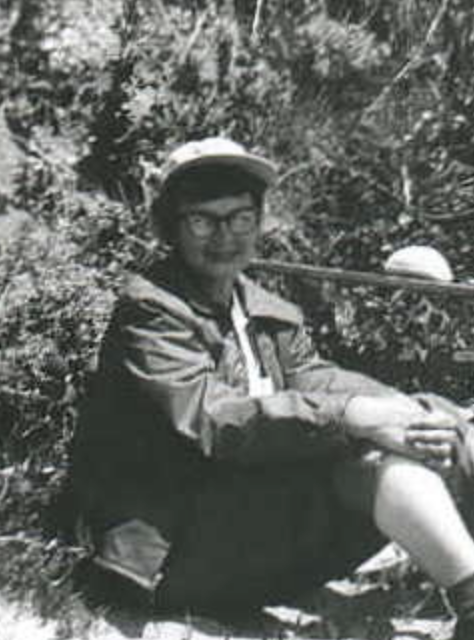
Photo from Ancestry.com
Davina Kosh (born Davina Elizabeth Prendergrast, April 6, 1904, Colma, California, U.S.A.; died January 8, 1994, San Rafael, California), bonsai master and poet. She published more than a hundred haiku in leading American and Japanese journals, most notably on bonsai and other Japanese-themed topics, and produced Brushstroke, a collection of her haiku in 1990. She was a long-time resident of San Rafael, California.
Background
Davina Elizabeth Prendergrast was bom in Colma, California, just south of San Francisco, daughter of Morris Thomas Prendegrast, Sr. (1872–1946), a gardener by profession, and and Emma Hirsch (born 1878), a native of Guatemala. The family lived in several northern California cities, including Sacramento, Alameda, and Oakland, when Davina was a child. In 1924 she married Charles Edward Eisen in Alameda; their son, Jack Edward Eisen was born in Oakland the following year. The couple was divorced by 1930, however; in that year Davina was living with her parents in Oakland and she was working as a secretary in a bank. She was married again in 1934 in Alameda to Albert Foster Kosh (1897–1975), and they moved to San Rafael, California. Their son Peter Robert Kosh was born in 1936 and died in 1944.
Kosh stated in her author’s biography for the San Francisco Haiku Anthology in 1992 that writing had always been a part of her life. She began publishing poetry in 1946 and self-published a book, Poems, in 1972. “In 1960 haiku was finally recognized and offered as a distinct form in an annual contest sponsored by a prominent poetry organization. Winning first prize in this category, I invested the five dollars in D. T. Suzuki’s Zen and Japanese Culture.” She pursued her new interests in bonsai, Zen, and Japanese culture in college courses and a trip to Japan. She began submitting her haiku to bonsai magazines in the 1960s and transliterated haiku and senryu with bonsai master John Naka. Their joint efforts were published in Bonsai Clubs International magazine in 1971. In Cor van den Heuvel’s The Haiku Anthology (1974) Kosh discovered what she calls “the mainstream of modern haiku,” and in 1985 she began submitting her work to the established haiku journals.
Kosh was a charter member of the Haiku Poets of Northern California (1989), but apparently never joined the Haiku Society of America or the northern California–based Yuki Teikei Haiku Society. Her sole collection of haikai, Brushstroke, was published in 1990 by Jane Reichhold’s AHA Books and Reichhold published Kosh’s work in her journalMirrors; a sketch of Kosh was not included in Reichhold’s guidebook Those Women Writing Haiku (2000). Kosh mentions the encouragement of Robert Spiess, Elizabeth Lamb, and Doris Heitmeyer as particularly instrumental in getting accepted in leading haiku journals beginning in 1987.
In the author’s blurb for Brushstroke, published four years before her death, Davina Kosh sums up her life in haiku: “This volume of haiku is the culmination of forty years of observing the world around [me] and capturing certain moments of awareness into what [I like] to describe as the swiftness of a brushstroke.
The Haikai of Davina Kosh
Davina Kosh published more than a hundred haiku and senryu, first in bonsai magazines in the 1960s and, beginning in the late 1980s, in mainstream haiku journals, notably Modern Haiku, Woodnotes, Frogpond, and Brussels Sprout. A major theme of her work was, as one might imagine, bonsai.
| bristlecone pine eternal bonsai windcarved among stars | Kosh, Brushstroke (1990) |
| morning ritual I bow to the tree it leans toward me | Woodnotes 1 (Spring 1989) |
| miniature bamboo grove even in the smallest pot the Buddha | Kosh, Brushstroke (1990) |
She also wrote verses on other Japanese themes, many likely based on experiences during her trip to Japan:
| journey … the winding path to the tea house | Kosh, Brushstroke (1990) |
| suiseki fingering the distant peaks of a memory | Kosh, Brushstroke (1990) |
| Ryoanji Stone Garden one leaf disturbs the flow of the naked sand | Kosh, Brushstroke (1990) |
| Issa Shiki listen I too would catch the moon | Modern Haiku 22:1 (Winter–Spring 1991) |
Kosh’s other haiku most often dealt with themes in nature, especially animals:
| a rainbow pouring in two directions | Kō (Autumn–Winter 1991) |
| facing sunset a row of doves changing colors | Modern Haiku 20:2 (Summer 1989) |
| a persistent blue jay tugs at what’s left in the walnut | First Prize, Capping Lines Contest, Dragonfly 15:1 (Winter 1989) |
| A flash of deer disappearing down the hill— also my roses | Dragonfly 14:6 (Spring 1987) |
| disappearing hawk a small sound remains | Woodnotes 18 (Autumn 1993) |
She also produced more personal, senryu-like verses:
| tasting a lifetime … one morning’s search for an old recipe | Brussels Sprout 8:1 (January 1991) |
| BEKINS after the breakup the very last to go the hope chest | Kosh, Brushstroke (1990) |
| Barefoot— on a particular beach— his ashes | Modern Haiku 19:1 (Winter–Spring 1988) |
Davina Kosh died at age 89 in 1994 in San Rafael, California. Modern Haiku published this haiku of hers in memoriam:
| unclenching my hands the bird flies away with my warmth | Modern Haiku 25:2 (Summer 1994) |
Sources / Further Reading
Books and chapbooks by Davina Kosh
- Kosh, Davina. Poems. Published independently, 1972.
- Kosh, Davina. Brushstroke. Gualala, Calif.: AHA Books, 1990. 76 haiku.
Other works mentioned in text
- Reichhold, Jane. Those Women Writing Haiku. Gualala, Calif.: AHA Books, 2000. Available online at https://www.thehaikufoundation.org/omeka/files/original/133bdb4477b11474afdfb142afbe7427.pdf.
- van den Heuvel, Cor, ed. The Haiku Anthology: English Language Haiku by Contemporary American and Canadian Poets. Garden City, N.Y.: Doubleday Anchor Books, 1974.
Haikai in anthologies and longer articles
- Ball, Jerry, Garry Gay, and Tom Tico, eds.. The San Francisco Haiku Anthology. Windsor, Calif.: Smythe-Waithe Press, 1992.
- Haiku Society of Northern California. Sandpipers. San Francisco: Vide Press of Smith-Waithe Press, 1988. 1 haiku.
- Katō Kōko, ed. Four Seasons: Haiku Anthology Classified by Season Words in English and Japanese. Nagoya, Japan: Kō Poetry Association, 1991. 2 haiku.
- Reichhold, Jane, and Werner Reichhold, eds.. April Fool: The World’s First and Only Haiku Collection of Its Kind in the World!. Gualala, Calif.: AHA Books, 1991. 2 senryu.
- Trumbull, Charles, “Earthquakes (and Tsunamis)—from A Field Guide to North American Haiku 19,” Frogpond 46:3 (Autumn 2023). 1 haiku.
Haikai in print periodicals
- BCI Bonsai & Stone Appreciation
- American Bonsai Society Journal
- Bonsai Down Under (Australia)
- The Florida Bonsai Magazine
- Golden State Bonsai Federation publications
- Modern Haiku, 1987–1994. 23 haiku.
- Frogpond, 1987–1991. 11 haiku.
- Dragonfly, 1987–1989. 6 haiku
- Mirrors.
- Haiku Headlines, 1989–
- Woodnotes, 1989–1991, 14 haiku.
- Brussels Sprout, 1990–1994. 8 haiku.
- Kō, 1991–
Reviews and biographical information
- “In Memoriam Davina Kosh, 1904–1994,” Frogpond 17:1 (Spring 1994), 12.
- Little, Geraldine Clinton. “Brushstroke, by Davina Kosh.” Modern Haiku 22:1 (Winter–Spring 1991), 83.
- “In Memory of Davina E. Kosh, April 1904—January 1994.” Modern Haiku 25:2 (Summer 1994), 25.
- Williams, Paul O. “Review of Davina Kosh, Brushstroke.” The Red Pagoda 6:2 (Autumn 1990), 24–25.
- Books Received, Brussels Sprout 8:1 (January 1991), 21.
- “Kosh Family Tree” and various genealogical records, Ancestry.com website.
Work in linked forms
- “Safe in the Arms” [haibun], Woodnotes 3 (Autumn 1989).
- “A Moveable Memory” [haibun], Woodnotes 10 (Autumn 1991).
- “1936—Outside The Old Wing Sing” [haibun], Brussels Sprout 11:1 (January 1994).
Awards
- Winter 1989 Capping Lines Contest, Dragonfly 15:1 (Winter 1989), First Prize.